There has been at least one elite tight end in each draft since 2021. 2020 was the last time that no one in an entire tight end draft class became an elite receiver. 2023 almost broke the streak, but with Tucker Kraft finally making his true breakout in 2025, the bridge was built. This year's class has one very obvious player with the potential to join that group, but few beyond that worth putting much thought into. The haters are right this time.
One note about Tight Ends, there haven't been many good ones in the last decade, leaving a lot of room for new avenues of finding contributors. Keep that in mind.
This model only uses on-field performance and nothing else. There’s no market share or dominator ratings. No breakout age or other biographical information. No combine data. The passage of time carries no weight here whatsoever. The draft position is completely ignored. And not a single second of film has been watched of any player. My model focuses on players who will have multiple years as top-performing receivers, rather than the usual "first 3 years top 24 PPG". Although a player with 1 great season and 2 bad ones is a hit there, that's a one-year window that you won't realize you have. I'd prefer to draft someone who leaves a bigger window for winning. Full disclosure: that does leave meat on the bone for players who can help win a championship but won't have careers worth holding them for.
This year's model is drastically improved over last year's.
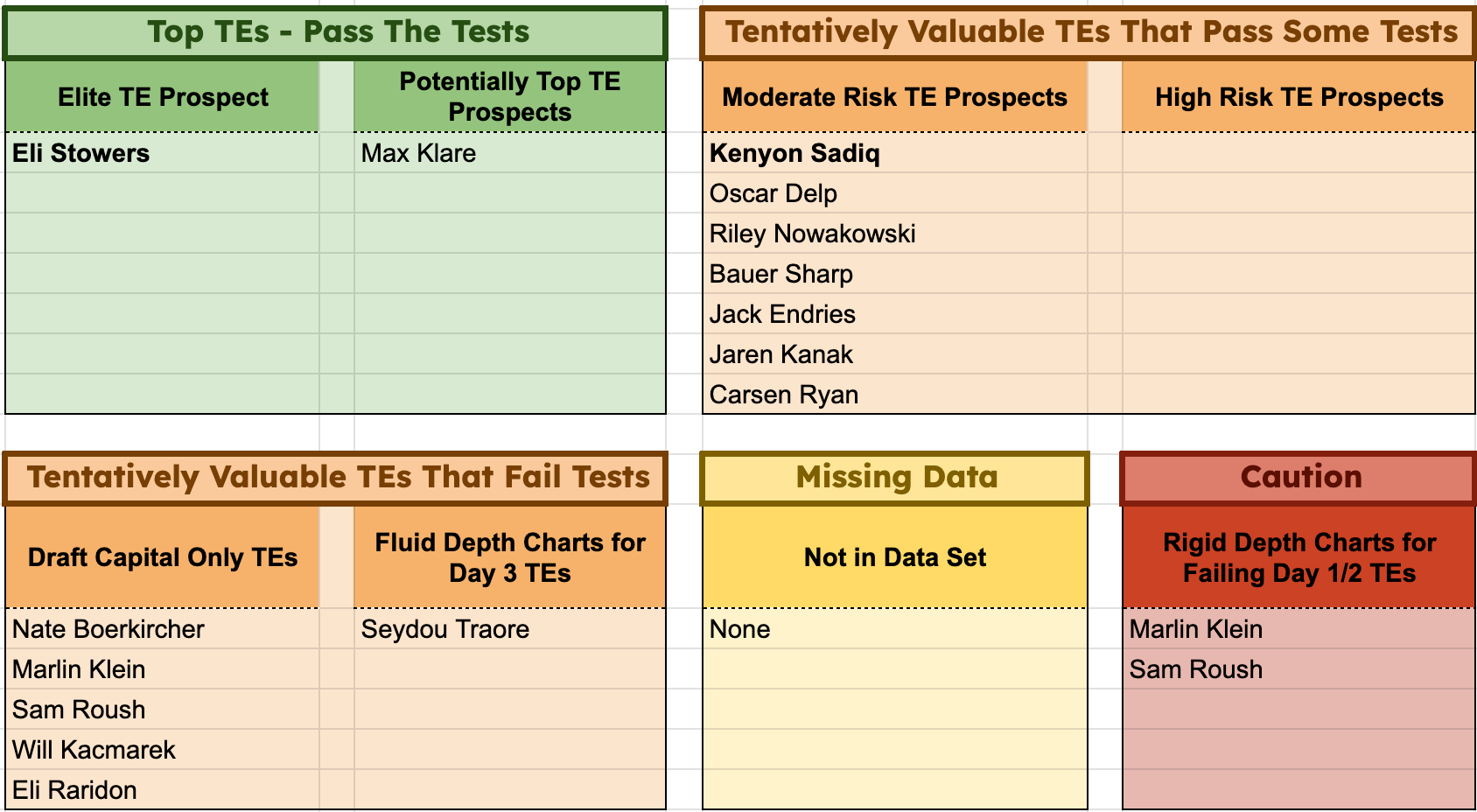
The players are listed in order by draft position, instead of being ranked. It’s self-explanatory which bucket is the best. I'm going to go section by section, defining each section and then giving some details on each player.
For the sake of making the writeups shorter, per-target efficiency refers to contestedless catch rate and yards-per-target. Per-reception efficiency refers to yac/reception and yards/reception. And "efficiency" on its own refers to all four of those values.
Elite TE Prospects
Players who show nearly no flaws in their profile. They should average more than 45 yards per game for their career and be threats for the #1 Tight End in any season.
Eli Stowers : Philadelphia Eagles : 54th Overall
The crown jewel of this year's tight end class, and I can't believe the Eagles got both of him and Lemon. Stowers didn't put up a catch until his third year of college football, but once he did, he tore it up. A crushing zone beater that's hard to cover with elite YAC skills on every target. Even on his 19 career deep targets, he was above the 70th percentile in catch rate, yards-per-target, yards-per-reception, and yac-per-reception amongst all drafted college tight ends from 2017-2026. It's unlikely for any tight end to make deep targets a part of their game in the NFL, but for someone as effective as Stowers it may add a wrinkle to his already impressive skillset if he can just...do it sometimes. If A.J. Brown gets traded before the season, it'll give the Eagles a great reason to use more 2-TE sets with both Stowers and Goedert and let him impress upon the NFL sooner.
Potentially Top TE Prospects
Players with a flawed game that still present as receiving threats. It's not impossible for them to put up over 45 yards per game, but it is likely they will be closer to TE8 to TE14.
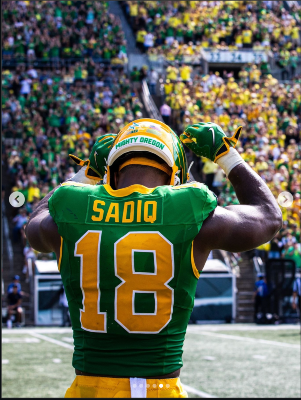
Max Klare : Los Angeles Rams : 61st Overall
Klare fits the mold of most non-elite starters. He's best in the short range where he can use his frame to get YAC. He can also get open in the intermediate, but doesn't do more than catch the ball before getting caught. And, like many modern TE prospects, he spent as much time in the slot as he did in-line for added versatility. However, for Klare to even get the chance to show he can do any of that in the NFL, he has to overcome one of the messiest Tight End depth charts in the NFL. Colby Parkinson, Tyler Higbee, and Terrance Ferguson all have their moments with the Rams, and Klare isn't a clear head-and-shoulders above them. Literally, he's the shortest of the four at 6'5. If last season is any indication, the Rams may continue platooning this group until Klare shows that he's capable of doing what the others can not. Unless Ferguson somehow beats him to it. That said, for the right price Klare is worth a target.
Moderate Risk TE Prospects
Players with more significant flaws. Most of these players will fail to make an impact, with higher picks from this group becoming serviceable TE8-TE20 types.
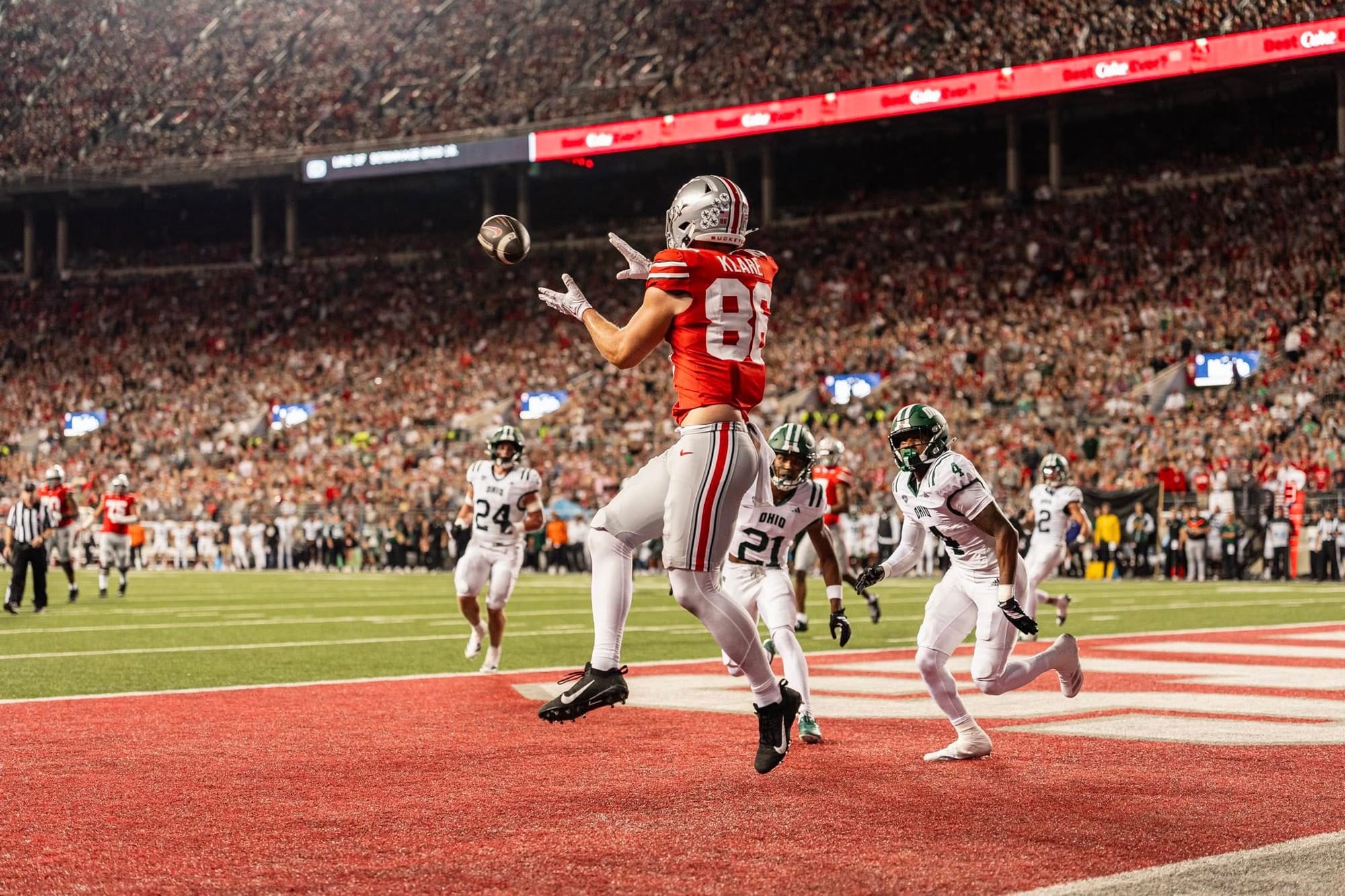
Kenyon Sadiq : New York Jets : 16th Overall
Yes, he's one of the most athletic tight ends of all time, I agree. However, I'm only interested in his production, and those do not reflect this caliber of athlete. Sadiq's 80% career catch rate is very high for someone with this much volume, but his ability to do anything after the catch was lacking and peaked at average. He was very good against man coverage, so I guess there just aren't a lot of college players that can cover WarGreymon 1-on-1. Geno Smith has twice been in the top 5 for short pass attempts since he took over for the Seahawks, which should give Sadiq opportunities without asking him to learn anything new. He'll have to put Mason Taylor to rest first, but I don't think that will be much of a challenge.
Oscar Delp : New Orleans Saints : 73rd Overall
Delp is a "balanced" tight end, also known as a generic "starter caliber" tight end. He can make an impact on short routes and can be a third option on intermediate routes. Although his college career ended with fewer than 100 targets, there are signs of a capable tight end within him. Juwan Johnson presents a real challenge to overcome before he can have value. However, maybe Delp's blocking, as he’s comparitively a regular-sized Rudy to Juwan, can help him stake his claim on an improving Saints offense.
Riley Nowakowski : Pittsburgh Steelers : 169th Overall
Look, I know he's likely listed as a fullback. But the Steelers are saying they also want him to line up as a tight end. So he's here. Nowakowski played Tight End for Indiana (450 snaps in-line in his 6th and final year) and was effective. In fact, on 48 career short targets, he is 96th percentile on yards-per-target and 99th percentile on contestedless-catch-rate. Even his per-reception numbers are both over the 70th percentile. If they let him keep playing tight end, then maybe he could have some value. However, I don't see the upside to risk drafting a fullback, so no thank you.
Bauer Sharp : Tampa Bay Buccaneers : 185th Overall
Sharp is boosted by his deep ball skills, which were better than most tight ends but came on only 9 career targets and is not what he'll be asked to do in the NFL. Sharp also proved he could handle his own against man coverage, which, unfortunately for him, is the less popular of the defensive coverage brothers. To keep it blunt, Sharp doesn't match the current NFL. To make it tougher for him, Cade Otton just received a contract extension that will keep him in the starting role for the next two years, barring insolvency.
Jack Endries : Cincinnati Bengals : 221st Overall
Endries was an average short-target in shifts with California and Texas, but had 75th percentile or better efficiency on intermediate throws over his career. That's on 36 intermediate targets, which is on the higher side for tight end prospects. On most teams that could make him a strange fit, but on the Bengals, it might make sense. Gesicki's play has been poorly received in 3 of the last 4 years, and it's even worse when he's blocking for the run game. Endries' chances of contributing might hang on how Erick All looks coming back from his second ACL tear.
Jaren Kanak : Tennessee Titans : 225th Overall
The Titans need better tight end performance than what they got out of Gunnar Helm last year, but Kanak may not be the right guy to do it. Kanak’s undersized and peaked at being only slightly above average. Late draft selection, small, and lacking an impressive resume mean Kanak has to really show out to even be considered.
Carsen Ryan : Cleveland Browns : 248th Overall
Ryan is slightly short for a tight end, but otherwise carries the right size. Unfortunately, his elite short target efficiency and skills at beating zone coverage all occurred during his final college season, leaving plenty of room for sample size issues. Even tougher, the Browns have Harold Fannin. Ryan has to prove he isn't just getting the benefit of being bigger and more experienced than everyone else. But seeing as he ended up in this bucket, I don't think he'll be able to beat those allegations.
High Risk TE Prospects
Players with even more flaws and more busts. These tight ends don't show top 12 upside, but might turn into low-level starters.
No Tight End prospects fall into this category this year, but, between you and me, almost everyone outside of Stowers carries a high risk.
Draft Capital Only TEs
No player within this sample has done anything of note for more than a single season's worth of time.
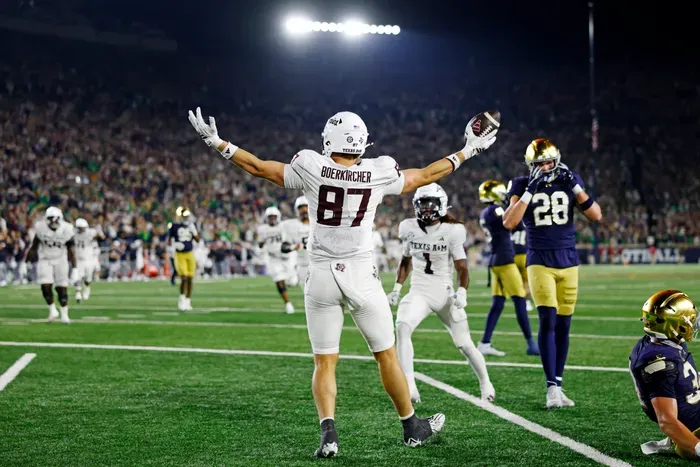
Nate Boerkircher : Jacksonville Jaguars : 56th Overall
Seldom used and seldom effective, Boerkircher's skills don't stand out even when he was utilized. Brenton Strange could be beaten by another tight end in the long term, but probably not by this one. Teammate Tanner Koziol would be much better suited to try his hand at pulling out the sword, but also unlikely to succeed.
Marlin Klein : Houston Texans : 59th Overall + Rigid Depth Chart
Klein had a productive senior year, but did so without showing a lot of skill. Of players that don't reach one of the buckets above and were also drafted within the top 100 picks, Klein is on the low end for practically everything. And to make his path to relevance even tougher, Dalton Schultz is coming off one of his best and most utilized seasons. Klein's chances of surpassing Schultz are near-zero to me and i'm doubtful of his ability to be more than a spot-starter if opportunity does come, so I’m looking elsewhere.
Sam Roush : Chicago Bears : 69th Overall + Rigid Depth Chart
Other than having 177 college targets over his career (20th highest for drafted tight ends from 2017-2026), there isn't anything else that stands out for Roush. But it’s incomprehensible to me that a second-round pick was spent on a team's third tight end, and that player doesn't even look special.
Will Kacmarek : Miami Dolphins : 87th Overall
Kacmarek only ran a route on 55% of his pass snaps in his final year at Ohio State. Max Klare usurped him after transferring in from Purdue. And for good reason. His ability to beat man coverage over his career is the only avenue that might give him a leg up on other competition.
Eli Raridon : New England Patriots : 95th Overall
Out of all tight ends drafted since 2017 that do not fall into any of the above buckets and are within the top 100 picks, Raridon has the best production against zone coverage. That is mostly boosted by his 99th percentile yards-per-target on the deep ball. As I keep saying, that is not a role tight ends have in the NFL. Hunter Henry is also not an easy player to toss aside.
Fluid Depth Charts for Day 3 TEs
The players here don't pass any tests, but landed on teams that haven't figured out their starting lineups or have players at risk of losing their starter status. The tight ends in this group make a good end-of-draft pick just because they might return early value even if it doesn't result in a real long-term producer. This is out of the scope of the model; they’re just my observations.
Seydou Traore : Miami Dolphins : 180th Overall
Look, if they're on the Dolphins and they're not playing running back, they landed in a good spot. Traore had 181 targets over his college career (far higher than the teammate drafted 3 rounds before him) and showed average or better efficiency in the short area. Along with above-average YAC skills across the board. Dulcich isn't an easy player to beat, but he's beatable on a depth chart. Traore has a chance of doing that.
Although they're already listed above, I will mention Jack Endries again as a late tight end with a chance to make a play on the starting job.
Also, go and take a look at the models' results for Wide Receivers.

Member discussion: